
CTC System
This text was prepared with the assistance of Micheal Urlaub
CTC History
TCDD CTC (Central Traffic Control / Demiryol Trafiğinin Elektrikli Sinyallerle Merkezden İdaresi) is an automatic block signaling broadly similar to the standard OSJD recommendations (or OSShD Organization for the Collaboration between Railways). These recommendations were themselves derived from German practice, albeit with a reduced number of lights. OSJD recommendations are more or less followed by most Central European operators including the Russian railways and even some non OSJD member railways such as TCDD.
TCDD current policy is to upgrade line signaling prior to electrification, but the two projects are usually linked. There are cases such as Ankara area where electrification was done before the CTC signaling.
CTC was developed after DRS and because of their common German ancestry, the two systems have several similar signal aspects. The main difference is the green light. In CTC-area, green indicates (if shown from a high signal) a basically unrestricted running until the next signal. In DRS area, a green can be by a main signal displaying "diverging route". In such a case, the driver will have to reduce speed even after a green.
CTC is currently installed on the following lines:
- Haydarpaşa - Ankara - Kayaş (installed from the late 1960's until the late 1970's by Westinghouse), This project included a phase 2 to reach Irmak and Zonguldak but this phase was not done
- Kayaş to Çetinkaya: installed in the mid 1990's. Hanlı to Sivas and Çetinkaya might not be in operation yet (as off 2002)
- Divriği - Çetinkaya - Malatya - Fevzipaşa -Toprakkale Iskenderun (installed in the late 1980's by Iskra from Yugoslavia)
- Halkalı - Edirne - Kapıkule.
- Izmir area: this is currently being done and is not yet operational (work started in 2001).
Most of these lines are single track lines with a maximum permissible speed of 120 km/h. The block sections are on average about 5 km long.
The CTC Dispatcher
The CTC dispatcher has a critical role, especially for single lines. The dispatcher is responsible for an area for one or several main lines, including all the stations in this area.
By default, each single line between two stations is closed. All the signals protecting this single line display a stop aspect. For an approaching train the dispatcher will set the route. The interlocking will clear the signals to a proceed aspect only if the selected route or open line is not occupied by another train and no conflicting movement was allowed.
The dispatcher will then organize the passing of the trains (either crossing or overtaking) in order to optimize the train movements and the line capacity. This is done using classical tools:
- forecast and actual graphics of all train paths.
- visual display of track layout showing signal status and trains locations.
- telephone and train radio (when available).
Type of signals and signal indications
There are basically three types of signal:
- a high signal with three lights: red / green / yellow (see 33H below)
- a high signal with four lights: yellow / red / green / yellow (see 44H below)
- a ground (i.e. short) signal with three lights: red / green / yellow (see 33D below). This signal is placed at rail level in dense area such as stations. Such signals authorize, when cleared, the passage over points in diverging position only. This signal can display flashing (blinking) aspects.

Note about speed
Normal authorized speed refers to the permissible speed as indicated in the driver's working timetable of other applicable document. In station, speed can be reduced over points in straight position. For example, 30km/h is the normal speed for the entrance or Ankara or Haydarpaşa stations.
Reduced speed refers to the speed over points set for the diverging track. The standard TCDD value for reduced speed is 30 km/h. But 40 km/h or even 50 km/h might be permitted in some stations. But in some cases, drivers may go as low as 10 km/h in application of notices in the driver's working timetable.
Limited speed refers to line of sight driving: the driver must be able to stop its train within its line of sight, he must set the speed accordingly. The driver must be prepared to stop short of a train, locomotive or vehicle, a broken rail or points in the wrong position. Limited speed must not exceed 25 km/h.
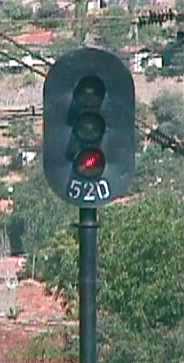
TCDD CTC signals. Kayas 2002, Photo Ergin Tönük | 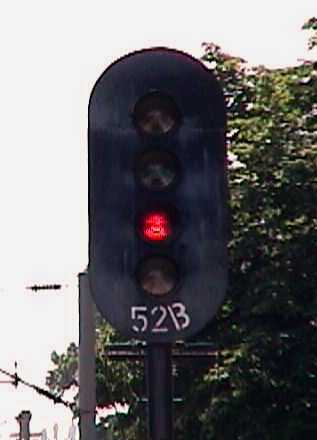
Kayas 2002, Photo Ergin Tönük |
Stop aspect
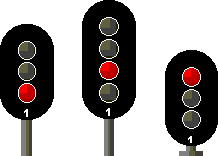 |
1) Immediate stop. |
Proceed aspect
 |
2) Proceed at Normal speed. Next signal is also a proceed aspect (i.e. not a stop). Two blocks beyond the signal are clear. 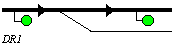 |
 |
3) Proceed but expect to find the following signal at stop or giving access to a diverging route. 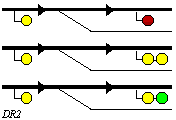 |
 |
4) Proceed at reduced speed over points set for a diverging route. Be prepared to stop at following signal. 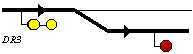 |
 |
5) Proceed at reduced speed over points set for a diverging route. Be prepared to proceed at following signal.  |
Flashing Aspects
Ground signals can control the exit from more than one line by exhibiting special aspects. The normal aspect which is given by a steady light applies for the line which is situated on the left hand side of the signal. Flashing aspects authorize the exit from a non track-circuited line or from a non track-circuited area which is situated on the right or on the left hand side of the signal. A "YS-Board" (YS stands for "Yanar Söner" - Flashing) terminates the track or the area, and may be passed only if the appropriate Ground Main Signal displays a flashing aspect.
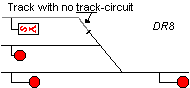 Basic situation | 
YS board and ground signal showing a stop aspect. Kayaş, 2002. Photo Ergin Tönük. |
 |
Passing of the YS-Board is permitted and exit is authorized from the non track-circuited line or area adjoining the ground signal. Limited speed applies in the point area. The next main signal authorizes normal speed or reduced speed. The exit from the line at the left-hand side of the signal is prohibited.  Note: if the ground signal displays a fixed green, then see case 2 here above. 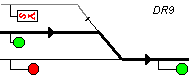 |
 |
Passing of the YS-Board is permitted and exit is authorized from the non track-circuited line or area adjoining the ground signal. Limited speed applies in the point area. The next main signal is at stop. The exit from the line at the left-hand side of the signal is prohibited. 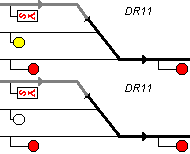 Note: if the ground signal displays a fixed yellow, then see case 3 here above.  |
Subsidiary aspect
 |
6) Proceed at limited speed as far as the line is clear. Be prepared to stop short of any obstruction.  |