
56901 to 56910
- Axle: 1'E
- Total quantity: 10
- First year: 1917
- Manufacturer: Henschel
- Last one scrapped around 1953
History
During the First World War, The Ottoman War Ministry ordered 15 engines to Henschel. The Ministry gave very few specifications beside a type 1'E engine, a speed of 50km/h and the requirement to get a high tractive effort suitable for Turkish gradients. Henschel had therefore the opportunity to design freely a new engine. The starting point was the G121 that was already being manufactured since 1915 for military purpose. From there, Henschel engineers made several very important innovations and the result could be considered as an entirely new engine, despite having many common parts and look with the G121.
First, the boiler was raised by 800-mm to place the firebox above the frame. The grate width was no longer constrained by the frame thus Henschel could make a large square grate. The fireman found this grate much easier to load than the narrow and deep grate previously encountered on large engines. The square Crampton firebox was of the same width than the boiler resulting in an improved efficiency in terms of fire temperature and heat transfer. The firebox sides, being shorter than before, where cheaper to build.
The raising of the boiler created a big gap between the boiler and the frame. The frame was freed from all mechanical constraint from the boiler that is more rigid and the overall dynamic behavior of the engine was actually improved. Being more elastic, the frame crack resistance was also improved. Finally all the axle suspension were linked one another giving a smooth ride even on poorly laid track.
The three cylinders simple expansion design of the G121 was retained: this design gave a better overall balance and reduced the rod effort on the crank to values suitable for the manufacturing capability of the time. The inside cylinder was raised in the gap under the boiler. Thanks to this, the internal driving rod could reach the third axle instead of the second on the G121. In addition, the running plate was raised as well: the internal mechanism could be accessed from the engine sides for light maintenance such as oiling. This eased one of the main drawback of internal mechanism. To get the highest tractive effort, Henschel choose a small 1,25m wheel but the frame spacing was deigned from the start for a wheel size up to 1,4 m in order to increase the speed. The overall result was an engine of almost 2000-HP with the ability to pull an effort of 29-T on the hook.
These excellent results lead several German railways (Prussia, Saxony, Elsass Lothringen, Baden, and Wurtemberg) to order a similar engine with the 1,4-m wheel. These taller wheels required and improved boiler with a Belpaire firebox and an increased pressure (from 13 to 14 bar). They became known as G12 on the KPEV or type XIIIIH in Saxonny and 1479 of them were manufactured between 1917 and 1921. The units that remained in Germany after the war were subsequently numbered as BR58.
In 1926, when the newly created Deutsche Reischbahn Geselshaft (DRG) designed the new BR44, all the key features of the G12 were retained, except the firebox which was reversed to a Crampton firebox, just like the 56900.
The 15 engines ordered by The Ottoman War Ministry were built but only 10 could be transferred to Turkey before the end of the war. The Allies took over the remaining five in Germany in 1918. 4 of them went to Belgium and after to Luxembourg. The last one came in France, on the Chemins de Fer de l'Est were it became E5015, and then SNCF n°150A15. This engine was appropriately nicknamed "La Turque" in France.
Too bad that no units were preserved of this highly historical engine
Pictures
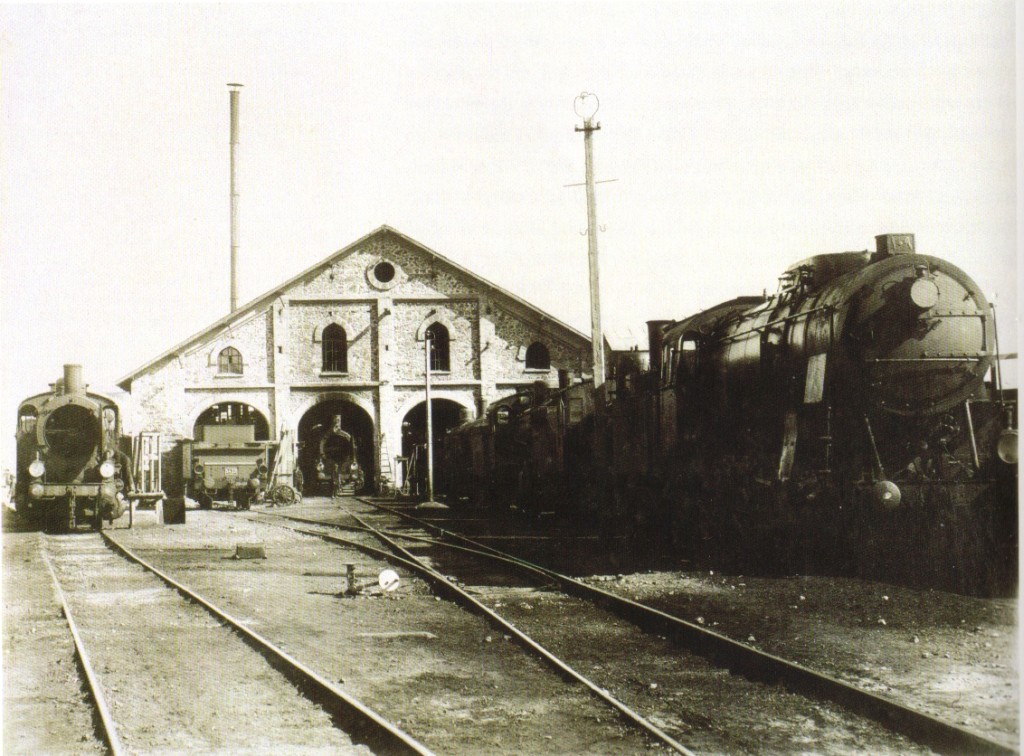
A very rare picture of a 56900, here 56909, still displaying its Ottoman War Ministry number 109 in Arabic numerals. Dated 1927. This picture is from the Ankara Sivas line opening memorial album, collection Atatürk Railway Museum in Ankara. Published in 'Demir Yol, Tren Çağı', page 16 | 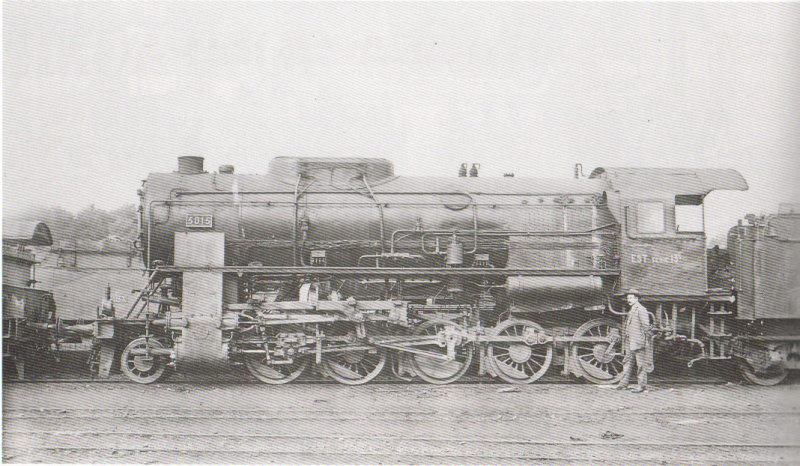
Although not a TCDD engine, I cannot resit showing this wonderful picture of 5015 "La Turque" at its new home Audun Le Roman also in 1927, on the French Compagnie de L'Est. Photo Pol Gillet, Collection Jean Florin, Published in "Decapod geules noires et trafic Lourd", Francis Villemaux, page 30. |
Engine numbering
| Henschel factory | War Ministry, 1918 | TCDD before 1940 | TCDD after 1940 |
|---|---|---|---|
| 14515 | 101 | 56001 | 56901 |
| 14516 | 102 | 56002 | 56902 |
| 14517 | 103 | 56003 | 56903 |
| 14518 | 104 | 56004 | 56904 |
| 15937 | 105 | 56005 | 56905 |
| 14520 | 106 | 56006 | 56906 |
| 15938 | 107 | 56007 | 56907 |
| 15939 | 108 | 56008 | 56908 |
| 15940 | 109 | 56009 | 56909 |
| 15941 | 110 | 56010 | 56910 |
Engine main characteristics
| Engine axle type | 1'E |
| Driving wheel dia | 1250 mm |
| Front bissel wheel dia | 820 mm |
| Rear bissel wheel dia | n/a mm |
| Number of cylinder | 3 |
| Cylinder diameter | 560 mm |
| Piston stroke | 600 mm |
| Boiler pressure | 13 bar |
| Grate surface | 4,5 m2 |
| Boiler pipe length | 5 m |
| Heating surface | 243 m2 |
| Superheating surface | 73,5 m2 |
| Overall length | 11,8 m |
| Fixed wheel base length | 3,1 m |
| Coupled wheel base length | 6,1 m |
| Overall wheel base | 8,5 m |
| Weight empty | 82 T |
| Weight loaded | 90 T |
| Adhesion weight | T |
| Load per driving wheel | T |
| Max speed | 50 km/h |
| Tractive effort | 29,3 T |
| Power (HP) | 1970 HP |
| Tender axle type | 3 |
| Wheel dia | 1000 mm |
| Overall length | 6,25 m |
| Wheel base length | 3,3 m |
| Tender water capacity | 12 m3 |
| Tender coal capacity | 5 T |
| Tender weight empty | 16,9 T |
| Tender weight loaded | 33,9 T |
| Loc + tender length | 18,2 m |
| Loc + tender wheel base | 14,9 m |
| Loc + tender weight | 123,9 T |