
A Short History of Turkish Railways
| Quick jump to: |
|---|
Introduction
TCDD was founded as a state company in 1927 by the new Turkish Republic to take over existing railways in Anatolia and to develop them in accordance with the needs of the country. Prior to the Republic, the Ottoman Empire awarded all concessions to private railways companies. These companies were financed by foreign capital except for the renowned Hedjaz Railway.
The Ottoman Government had little global network vision in their railway building and their projects can be categorized in two types:
- Projects sponsored by the Ottoman government, usually for strategic reasons (Hedjaz Railway, Baghdad Railway, …).
- Projects sponsored by private interests for business purpose (ORC, SCP, …), in area were the transport demand was already high. These projects were local and uncoordinated.
Although all the lines were connected at the time of TCDD creation, they did not constitute a network suitable for an efficient transportation. Large parts of Anatolia had no railways and some large cities were still not connected. A development program was prepared by the Republic government and entrusted to TCDD to carry it over. On average, TCDD doubled the size of the network (from about 4000 km in 1924 to 8500 km today)
Appendix:
- Chronology of some Turkish history key historical dates from 1850 to 1950
- The abbreviation page for details of railways and manufacturer abbreviations used.
Overview of railways in Anatolia
Before World War 1: the private companies
The table below shows all the companies in Turkey during the Ottoman time. Original names are most of the time in French, which was commonly used as international language in the Ottoman Empire in the late 19s century.
This table includes the branch line to Kars. Although not in the Empire at the time of building, this branch of the Transcaucasus railway was taken over when Kars was conquered by the Imperial armies in 1917
| Short Name | Full Original Name | Line | Start date | Taken over by |
|---|---|---|---|---|
| CO | Société Générale pour l'Exploitation des Chemins de Fer Orientaux | Istanbul to Bulgaria and Greece | 1874 | TCDD 1 January 1937 |
| ORC | Ottoman Railway from Smyrna to Aydin | Izmir to Buca, Aydin, Sarayköy, Dinar, Egridir | 1866 | TCDD 1 June 1935 |
| SCP | Smyrna Cassaba railway, renamed Chemins de fer Smyrne Cassaba et Prolongements | Izmir to Turgutlu, Alasehir, Usak, Afyon and Izmir to Bandirma, | 1869 | TCDD 1 June 1934 |
| CFOA | Société de Chemins de Fer Ottomans d'Anatolie | Istanbul, Izmit, Adapazari, Eskisehir, Ankara, Konya | 1873 | C.F. Anatolie Bahgdad 1 June 1927 |
| CIOB - CFIO Baghdad | Société Impériale Ottomane du Chemins de Fer de Baghdad or Chemins du Fer Impérial Ottomans de Bagdad | Konya, Adana, Toprakkale, Iskenderun, Islahiye, Meydanekbez, Nusaybin Baghdad | 1904 | C.F. Anatolie Bahgdad 1 June 1927 |
| MTA | Mersin - Adana | Mersin, Tarsus, Yenice, Adana | 1886 | TCDD 1 January 1929 |
| CFMB | Chemins de fer de Moudiana à Brousse | Mudanya Bursa | 1892 | TCDD 1 June 1931 |
| --- | Transcaucasus Railways | Sarikamis, Kars to border, plus 750 mm gauge line to Erzurum | 1899 | C.F. Anatolie Bahgdad 1 June 1927 |
First World War and Independence War
For various reasons not discussed here, the Ottoman Empire entered the First World War on the side of Germany and of the Austrian-Hungarian Empire and against France, the United-Kingdom and Russia. During the 1914-1918 period, no fighting occurred on the Anatolian soil but the "enemy railways" (the SCP, and the ORC) were placed under special military control until 1919.
In the aftermath of defeat, Anatolia was occupied by the Great Powers which in turn placed the "German railways" under special military control. However, fightings in Anatolia did start in 1920 when Greece proceeded with an attack and an occupation of Western Anatolia. The Turkish Nationalist, led by Atatürk, fought back and expelled the Greeks in 1922. These combats brought about heavy damage to the railways, especially in Eskisehir area.
During all this time, actual control and operation of the railway lines in Anatolia is quite obscure. It is likely that traffic was minimal and most of the equipment was not serviceable. Only parts of lines were operated by whoever had military control of the area.
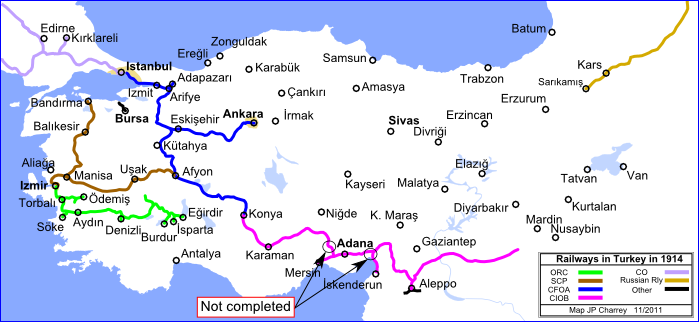
Schematic map of Turkey showing railway development at the eve of World War One.
A large area is left without railways. Drawing JP Charrey
After the War: railway nationalized through TCDD
After the War, a Turkish State company was formed to take over the railways that were under German ownership and lying in Anatolia under Turkish control. This company took the name of Chemins de fer d'Anatolie Baghdad and formed the nucleus of TCDD. All the railways belonging to the French or the British were returned to their former owners.
| Short Name | Full Original Name | Line | Start date | Taken over by |
|---|---|---|---|---|
| --- | Chemins de fer d'Anatolie Baghdad | Istanbul Izmit Adapazari, Eskisehir, Ankara, Konya, Pozanti, Adana, Mersin | 22 April 1924 | TCDD 1 June 1927 |
In addition, a company was created by the French, after WWI, to take over the part of the Baghdad railways that was in the area controlled by the French (Cilicia and Syria). This company was reorganized when the French withdrew from Cilicia, and again when the assets in Turkey were transferred to TCDD.
| Short Name | Full Original Name | Line | Start date | Taken over by |
|---|---|---|---|---|
| CNS | Chemins de fer de Cilicie Nord Syrie | Adana, Toprakkale, Iskenderun, Islahiye, Meydanekbez, Nusaybin, Baghdad, | 1918 | BANP 1927 |
| BANP | Société d'exploitation des Chemins de Fer Bozanti Alep Nissibine et Prolongements | Adana, Toprakkale, Iskenderun, Islahiye, Meydanekbez, Nusaybin, Baghdad, | 1927 | TCDD (partly) 1 July 1933 |
| CD | Société Turque des Chemins de Fer du Sud de la Turquie (Cenup Demiryolari) | Fevzipasa, Islahiye to Meydanekbez; Çobanbey to Nusaybin and Payas to Iskenderun | 1 July 1933 | TCDD January 1948 |
Second wave of line building
In addition to gradually taking over all the private railways, TCDD had a mandate for extensive line building to the point that it became the main expenditure of the government. This second wave of expansion occurred mostly in the 1930's and 1940's with the opening of important lines to places like Malatya, Ezurum, Samsun or Zonguldak
From the Second World War to present days
Turkey remained neutral during the Second World War. But after the war, with American aid through the Marshal plan, Turkey shifted its priorities from rail to road transportation. Over the years, bus and truck became the transportation of choice over the newly build roads.
The rail network expansion came slowly to a halt without being finished. In addition, under investment meant that line modernization was very slow. Steam engines were kept in service until very late in the 1980's. TCDD modernization program relies on modern automatic block signaling system and 25KV electrification of its main lines. Some double tracking and realignments have been done as well along the same main roads
Rail investment rebirth came through urban mass transportation. In the 1990's, urban networks, from light rail to heavy metro were inaugurated in most of the large Turkish cities. Transportation needs in large cities and road congestion brought about the latest shift in TCDD strategy. In the late 1990's, TCDD forgo its network expansion strategy and focused instead on the upgrade of the Istanbul Ankara mainline.
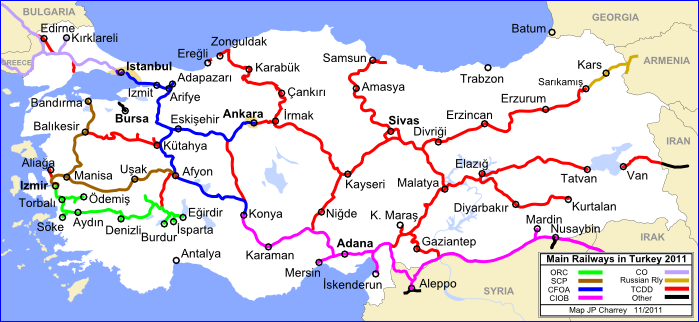
Schematic map of Turkey showing the final railway development. Drawing JP Charrey